Enginediy
Teching 1:4 Supercar V12 Engine Model Kit
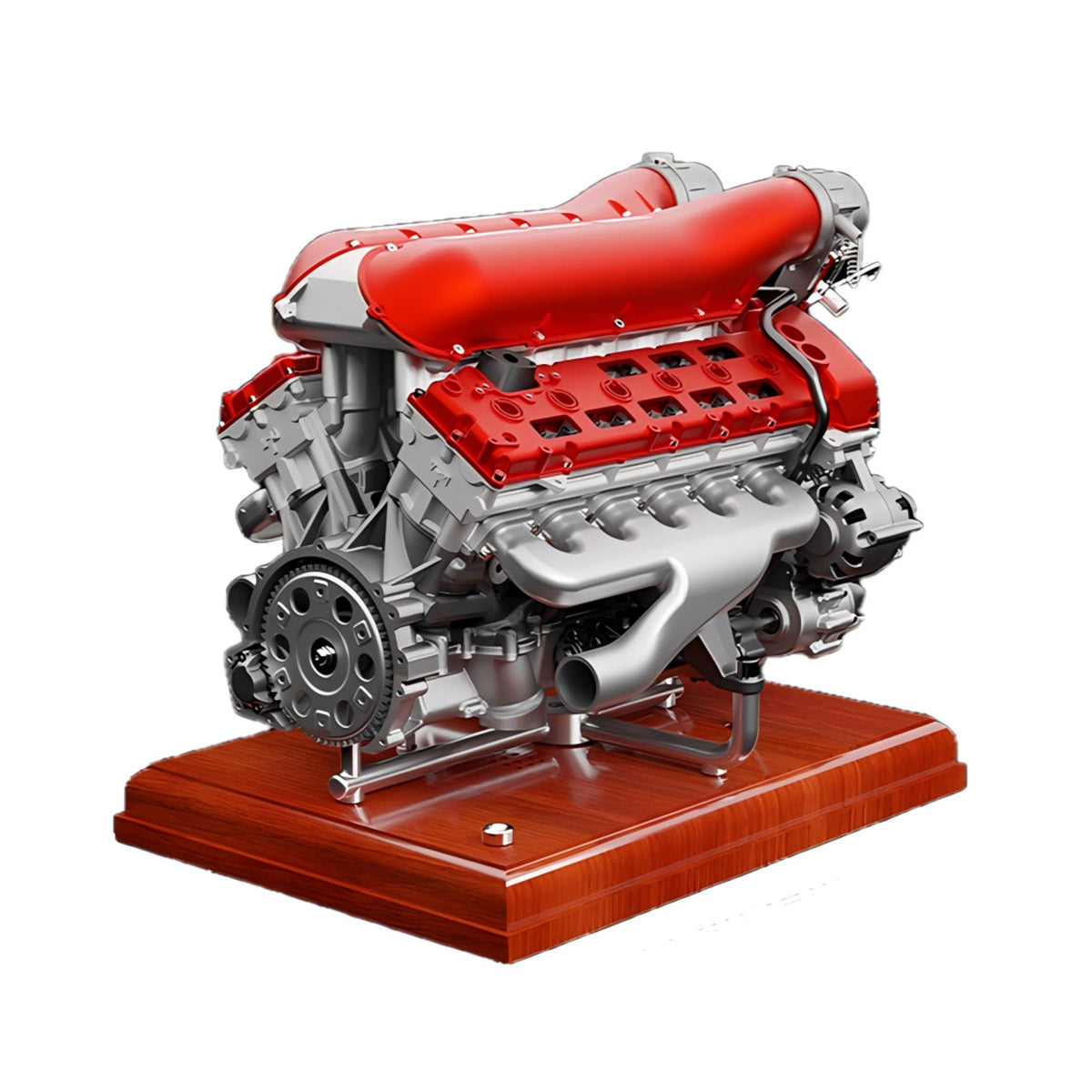
From video: Why Are Supercar Engines So Expensive? The Answer Will Change Your Perspective + Engine Giveaway
Published: January 18, 2026
Video Description
Engine from the video: https://www.enginediy.com/products/teching-1-4-supercar-v12-engine-model-kit-with-synchronized-throttle-sound-effects-800-pcs?ref=d4a
Use code "d4a" for a 10% discount on anything from: https://www.enginediy.com
Support the channel by shopping through this link: https://amzn.to/4fatbMb
Become a member: https://www.youtube.com/@d4a/join
Patreon: https://www.patreon.com/d4a
Why are supercar engines so expensive? If we compare something like a Ferrari V12 (F140HD from the current dodici cilindri) and let’s say a Toyota g16e-gts, the inline three engine you can find in the GR Corolla and Gr Yaris, you will see that both employ essentially the same technologies. Things like direct injection, CNC machined intakes, variable valve timing and lift. They also both employ almost the same materials, they have high grade aluminum-silicon alloys for the block and cylinder heads, aluminum for the pistons, forged steel cranks, sodium-filled exhaust valves. Both engines are also largely hand-built by expert technicians.
So why does the Ferrari engine cost 8 times more? Well, that’s the exact question we’ll be answering in this video and we will do it while assembling a all-metal scale model of a Ferrari v12.
Let us start with the engine block. The engine block is cast from Aluminum. What’s interesting is that Ferrari uses in-house sand-casting, a process which can be considered archaic by modern standards. It has low tooling costs, making it suitable for low-volume production while at the same time allowing the casting of large and complex structures with low porosity thick sections and the ability to cast thin walls and good overall strength. To achieve this Ferrari is pushing the limits of sand-casting using a highly skilled workforce and a lot of time invested in preparation of the molds and post-processing of the engine blocks.
Inside the block we have the crankshaft, which is forged steel in case of both the ferrari and the toyota g16e-gts. The difference here is that the g16e-gts revs to 7000 rpm. The Ferrari F140 HD engine as present in the current dodici cilindri revs to 9500 rpm. Remember, forces on the rotating and reciprocating components of the engine are proportional to the square of RPM. In other words, the Ferrari v12 revs 36% higher, but the internals experience 84% more stress. Getting a long and heavy v12 crankshaft to reliably survive 9500 rpm without twisting or breaking is a monumental task.
Next up we have the pistons and rods. The g16 has steel rods and cast aluminum pistons The f140 has forged aluminum pistons and titanium rods. Forged pistons are stronger whereas titanium rods are as strong as steel but noticeably lighter. Reducing the weight and improving the strength of the rotating assembly is critical for reliably achieving 9500 rpm
Another item that is a major cost driver on the Ferrari engine is a dry sump system, something that is not present on the toyota or pretty much on any other high-volume engine. Usually reserved for motorsport applications dry sump systems increase the power output of the engine by reducing pressure in the crankcase and ensuring optimal lubrication even in the most extreme of conditions.
So, why is it so expensive? If we add up the forged piston, and titanium rods, and hollow cams, and even the dry sump and the continuously variable intake ducts, we are realistically looking at an extra $35k-40k of manufacturing cost. So what’s with the rest of the money? Are you just paying for a Ferrari badge? Like those people who pay triple digit numbers for 100% cotton t-shirts with italian surnames on them?
Actually no. In the case of the Ferrari what you’re actually paying is for the engine to exist. Allow me to explain. Nobody needs a naturally aspirated v12 engine producing 830 horsepower. Looking at it pragmatically, such an engine is both pointless and unnecessary. It’s power and potential is realistically unusable in 99% of scenarios by 99% of drivers. On top of this the same or even higher power outputs can nowadays be achieved with a v8 or even a v6. Just slap a couple of turbos on it.
On the other hand, Ferrari chose to achieve 830 horsepower in hard mode. Why? Because they were never after power numbers. They were after the pinnacle of combustion-induced sensations. This is an irrational and impractical engine. In order for it to exist you need the most advanced engine technologies, the most skilled engineers and technicians together with the best materials and manufacturing technologies and an incredible amount of research and development. And then you take the very high total cost of all of these elements and spread it over a very low number of engines. The result is of course a very high cost per engine that must be paid in order for the engine to exist.
A special thank you to my patrons:
Daniel
Zwoa Meda Beda
valqk
Toma Marini
Cole Philips
Allan Mackay
RePeteAndMe
Sam Lutfi
Cakeskull
#d4a #ferrari #toyota
@enginediy